Startseite Archive für sophieinnmann Seite 3

Autor: sophieinnmann

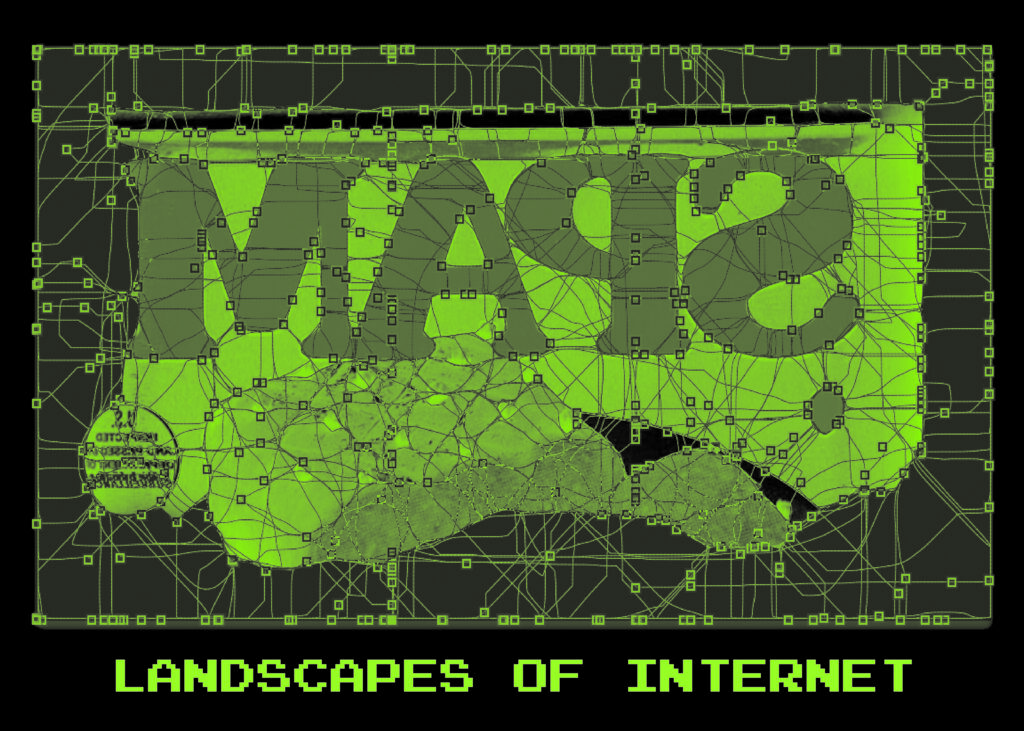
Landscapes of Internet

The solo show Landscapes of Internet took place in Kunsthaus L6 Freiburg from June 10 until July 11, 2021 and was curated by Jennifer Krieger.
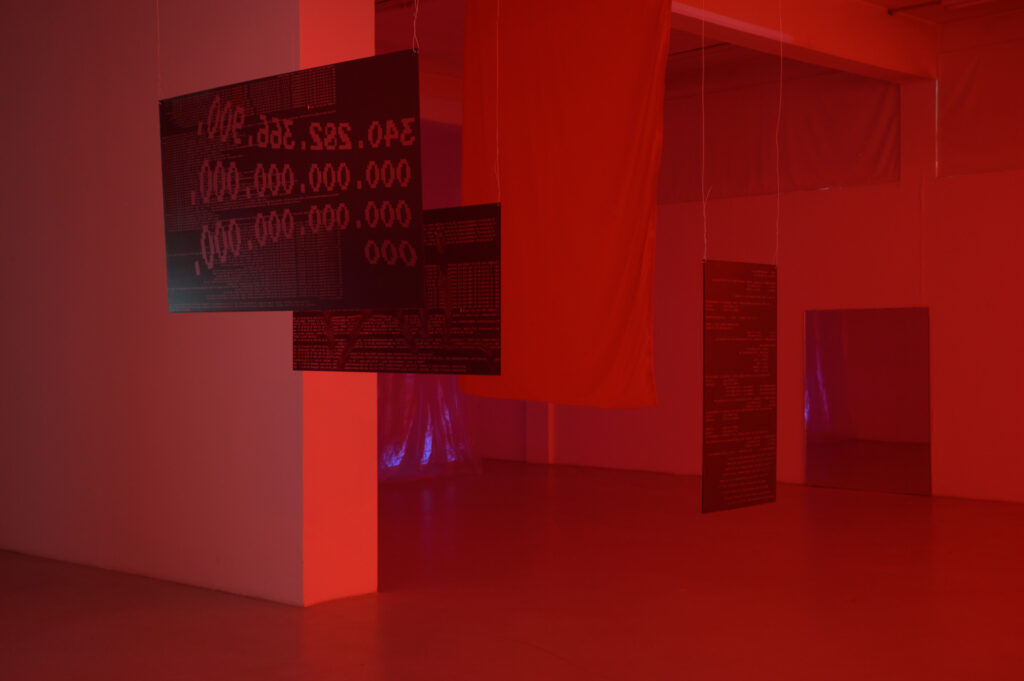
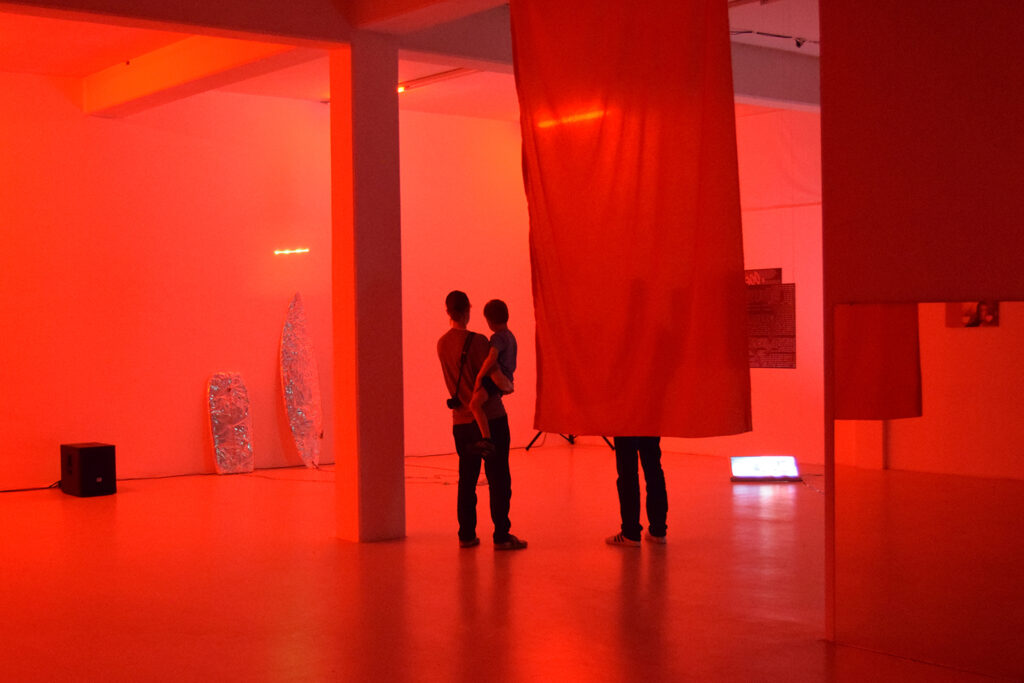
The show took you on a journey to the imaginary of a digital landscape, where you would find yourself confronted with technology and pure natural forces at the same time: the artworks were embedded in an atmosphere of sound, light, wind and smell.
The exhibition followed the ideas of sustainability not only concerning the topic of its content itself, e.g. how to live in times of progressing digitization and consumption of ressources of our planet, but also in the exhibition making: all material was borrowed, recycled or re-used.

About the theoretical reflections Jennifer and me published a text in frame-less magazine, which you can read here.

The following video takes you on a short trip through the exhibition. For the best audio experience I recommend wearing headphones.
The video recording was done with help of Michaela Klähn, the sound-of-Internet editing by Vincent Wikström.
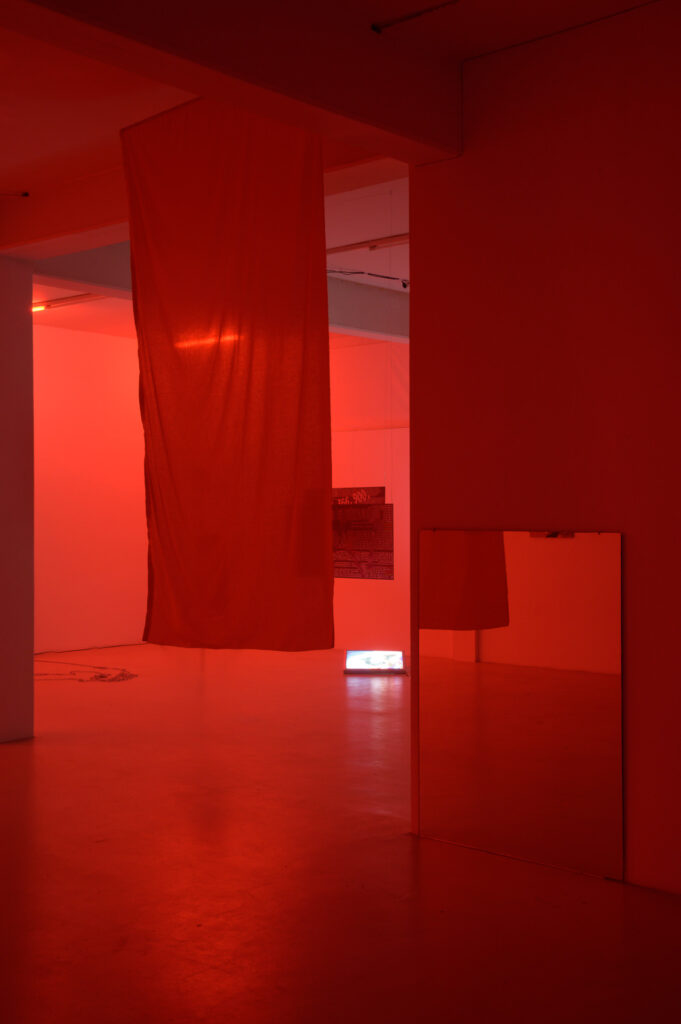
 

The question of possibilities, potentials and limits of space are at the center of the exhibition LANDSCAPES OF INTERNET. Starting from observations on current hypertopization effects of digitality, Sophie Innmann explores virtual as well as analog spaces in terms of their commonalities, differences and compatibility from the specific perspective of human perception. The possibilities, but also the limits of a real space are critically questioned by the artist. The reflections on this are influenced by the experiences of the social pandemic turn, but reach back even further: already in pre-Covid times, Innmann reflected on the existing paradigm of real (museum) space in her artistic production by questioning the specific characteristics of the institutional exhibition space: Where does this system reach its limits? What is special about the digital space? The exhibition in L6 aims to provide access to this intangible world of the Internet. Haptic, audio-visual experiences are combined with technological loopholes that allow a temporary opening of virtual space in real space. A walk through the landscape designed by Innmann thus re-creates a reference to a tangible reality by making the digital visible in accessible objects.

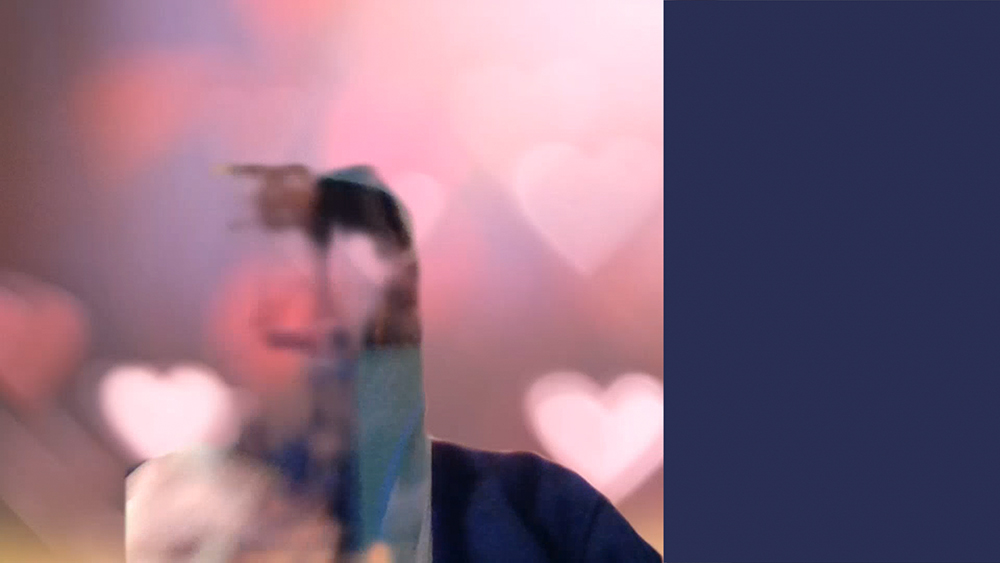
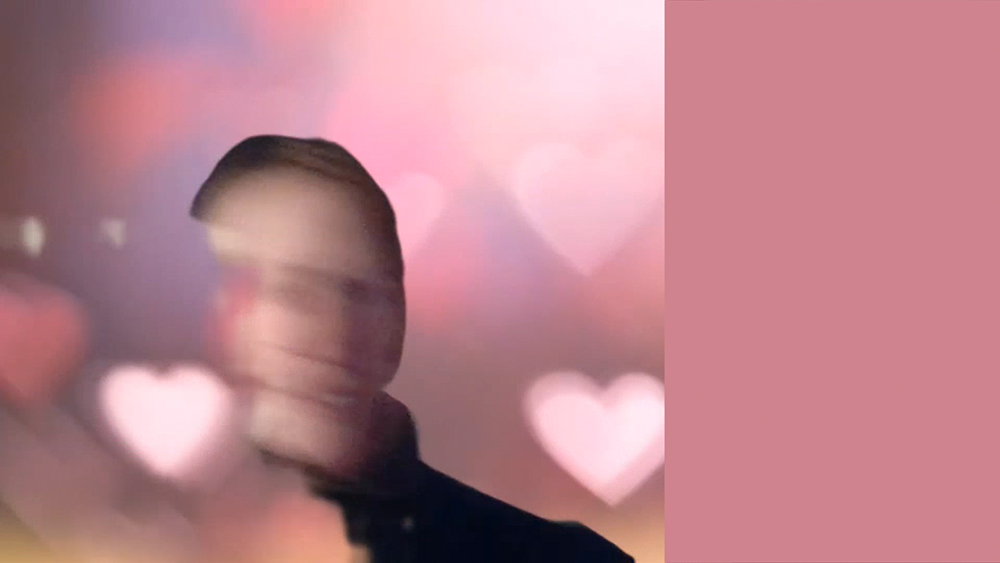
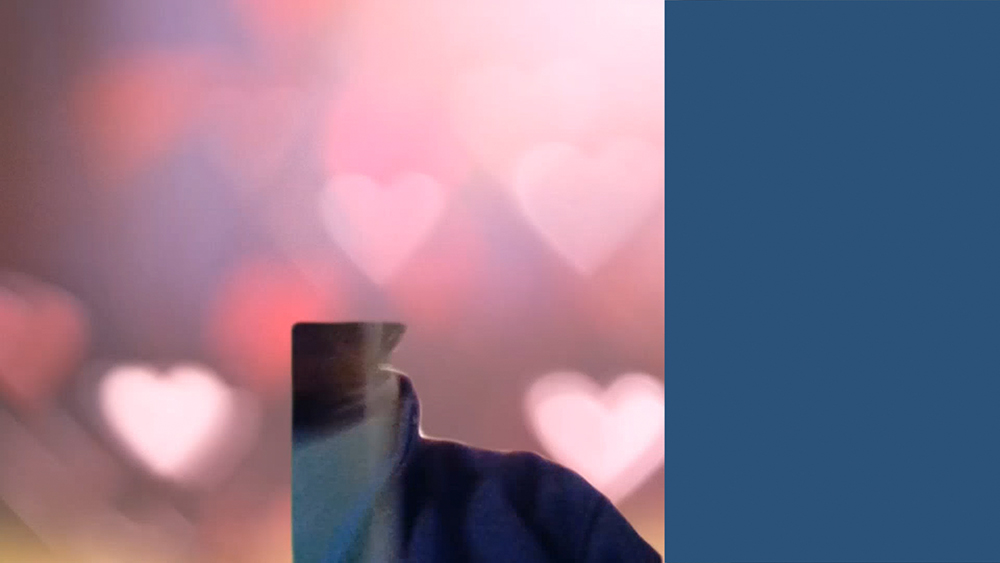
Visitors gain access only by crossing the firewall in the entrance area; the exhibition space itself is visually bathed in a subdued, atmospheric light. The other world, that of digital space, is made clear by a pervasive soundscape (The Sound of Internet, sound-engineering: Vincent Wikström). The omnipresence of the digital becomes palpable and a holistic, sensory experience. Innmann leaves the verification of whether one is granted or denied access to this world not to the system, but to the visitors themselves. The red flag (verification – red flag by default) is both a warning and an indicator of a potential threat. The view into the mirror runs into the void, respectively into the infinite space, which, however, obviously only represents an optical illusion. The series camouflage shows stills taken from a cloud-based video conferencing service in which virtual meetings are made possible. The true, direct encounter, however, remains absent in this format – through rapid movements, the artist manages to elude the camera and to conceal her identity, at least temporarily. Blurred, graphic images of her person emerge – pixelated fragments that remind us how much or how little each person is transmitting as data at this moment.

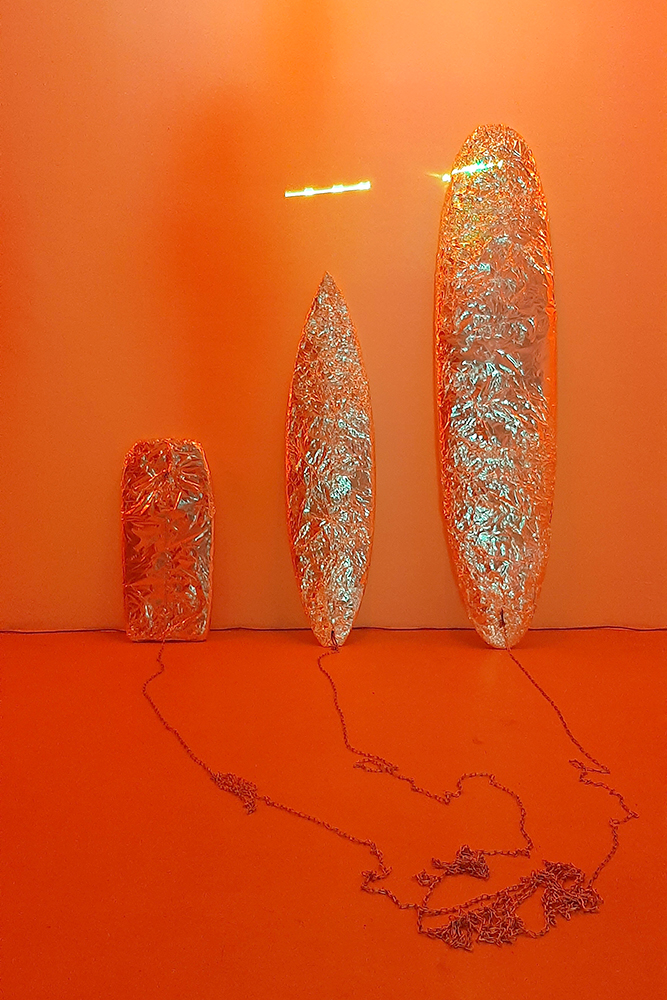
The critical questioning of the transparent user, who often carelessly feeds information into the digital system and feeds the virtual cloud with considerable amounts of data, is taken up in several of Innmann’s works. A laser beam hits surfboards and explicitly points to the process of scanning data and personal information (A user’s life), an unstoppable process in which users further chain themselves with every click and seemingly merge with the digital world (Fusion).
But is it possible to counteract this appropriation, to escape the algorithm and find anonymity behind IP addresses (no such user found)? Or does one remain trapped and henceforth move in an in-between space that is able to cleverly evade any approach and in this sense only represents a projection of an apparent reality (hypertopia)?

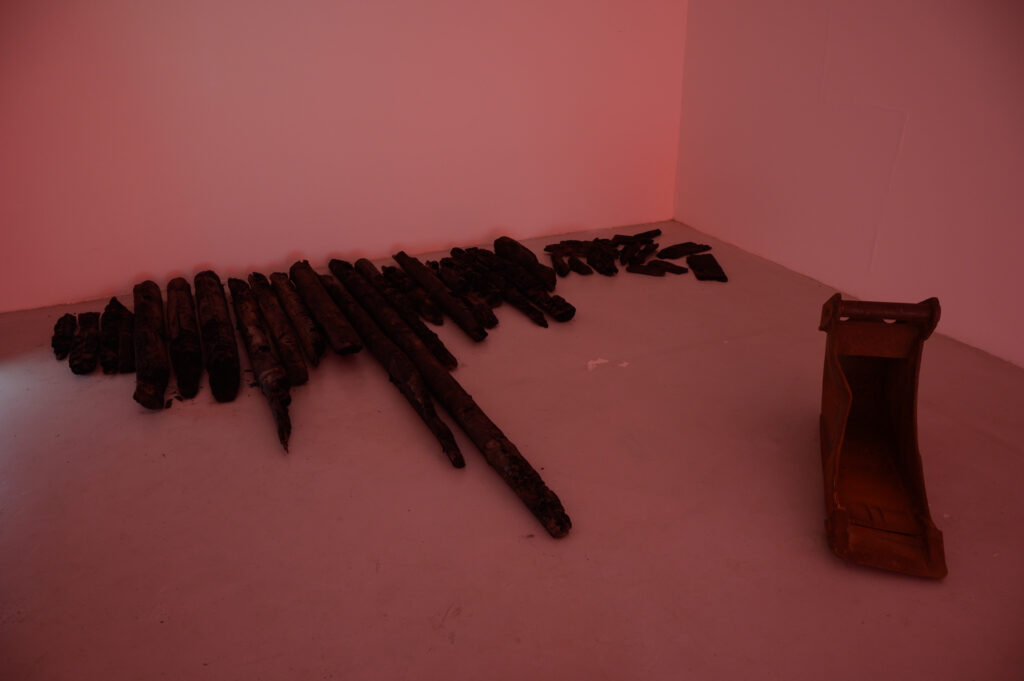
The walk through the exhibition ends with a return to existential elements of nature and thus inevitably refers to the overcoming of the wall of fire at the beginning of the exhibition. Tree trunks lie charred and burned out on the floor, a backhoe shovel placed next to them (Netflix and Chill). Not only is the exploitation of natural resources through the daily use of the Internet and the energy consumption of data storage devices brought to mind here, but also one’s own personal burnout, which has led to a routinized automatism. Innmann does not present an obvious strategy for overcoming this state; rather, she captures this feeling as a lasting disturbance: an incisive noise that forces a pause, a moment of pause (cloud calling).

Text: Jennifer Krieger, 2021
Rhapsody

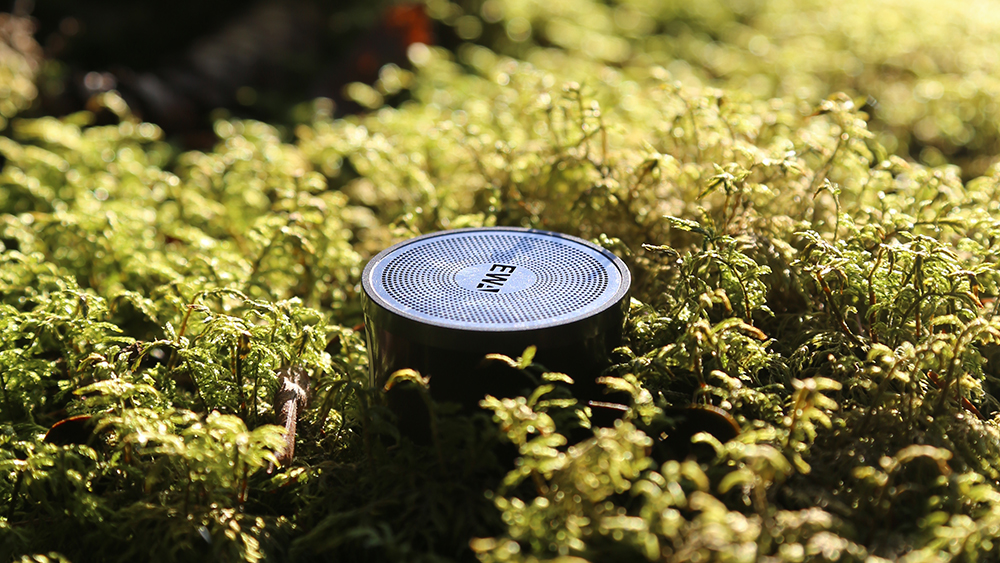
2022 | sound installation on 8 speakers mixing with forest sounds | created during the artist residency Schiesslhaus AiR for the exhibition Baierway in Kollnburg, Bavaria.

I encountered the term “Heimat” almost daily in the Bavarian Forest. In the supermarket on packaging, on the bus, while hiking and, last but not least, at the numerous Heimat festivals in the region.
Homeland, according to my impression, means for the people here a feeling of connection with the place where they were born or grew up, the keeping alive of local traditions and a feeling of pride about how beautiful and how good we have it here.

The concept reaches its limits when it comes to defining who belongs to this homeland and who does not.
What criteria must be fulfilled for someone to call something “Heimat” and, conversely, for it to be perceived as such from the outside? The coincidence of birth? Long residence in this place? The appearance? The language?

For Rhapsody, I invited people from Kollnburg and the surrounding area, who explicitly do not fit into the local idea of Heimat, to perform melodies that are connected to their personal concept of Heimat. Not sung, but whistled. Incognito, one could say. The marker „language“ as an identification feature of a certain homeland is excluded. Instead, the whistling of the people blends into the sound tapestry of the Bavarian Forest. People and birds now whistle together. They form a sonic image of homeland, which is one big whole, but still has different voices.

No Nations! No borders!

The melodies were whistled by Faysal Bougherara, Zsuzsa Gyetvai, Sophie Innmann, Anas Kahal, Joe Krasean, Vojtěch Novák, Swiatoslaw Palamartschuk and Laetitia Striffling.

Foto & video: Vojtěch Novák

S*** NATIONS

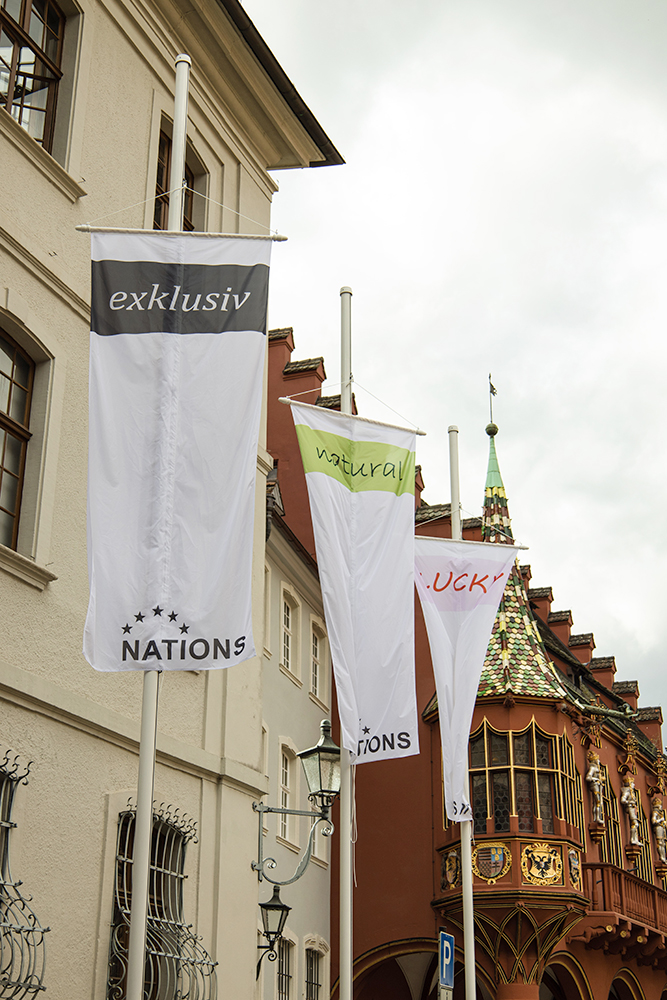
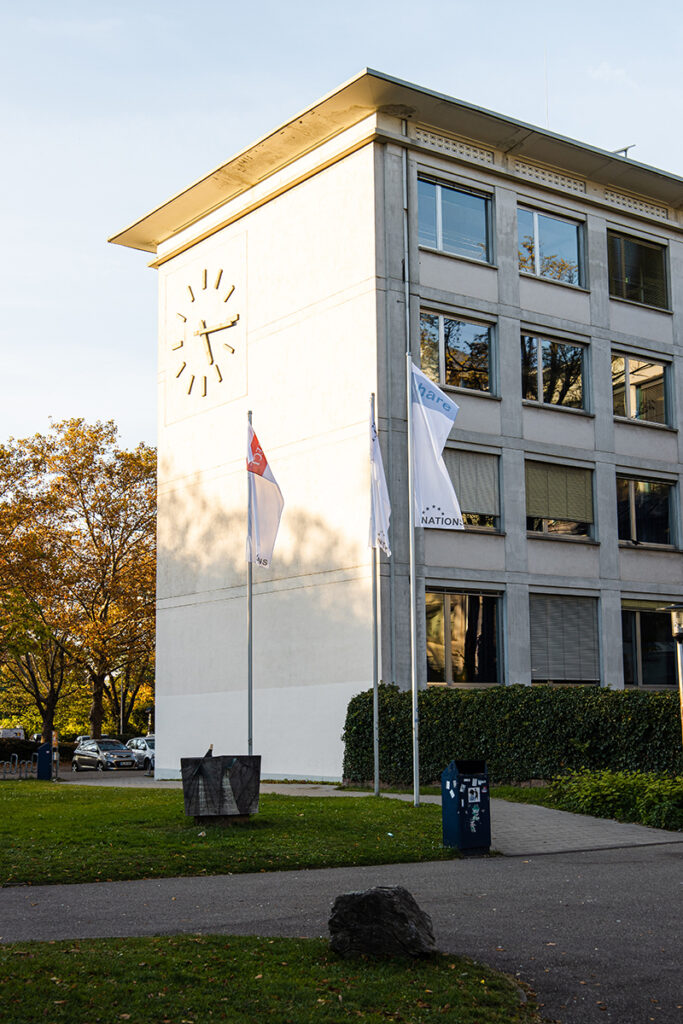
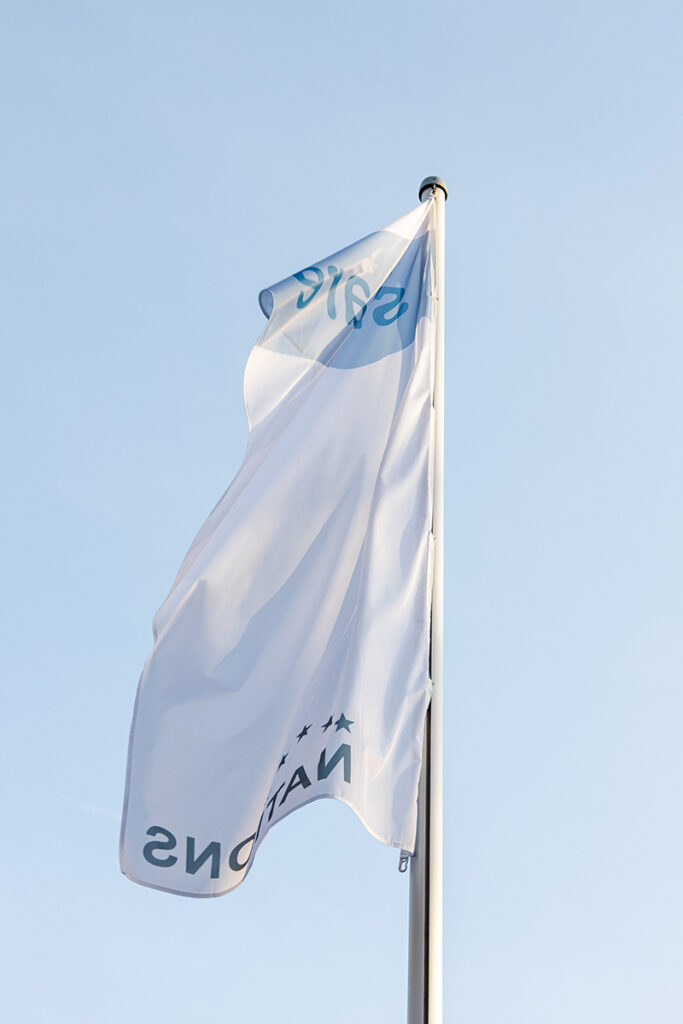
2020/2021 | 20 flags for public space | commissioned for Museum für Neue Kunst Freiburg


Flags are the epitome of nationalism and pride. They serve as objects of representation during warlike or sporting conflicts, as symbols of identification and sovereignty of states.
But how can one be proud of something for which one did not have to contribute anything at all? More coincidence than place and time of birth cannot occur to a human existence.

But flags can also be a means of protest against oppression and resistance against political systems.

S*** NATIONS establishes the connection between both connotations, as a reminder to all white* nations for whom the preservation of their privileges is more important than justice. The white flag stands for surrender worldwide and is recognized as a sign of protection under international law. The coloured terms are taken from the advertising slogans of various toilet paper brands, a product used almost exclusively by white* nations. Surprisingly, these advertising terms correlate strongly with structures of exclusion and closure, with characteristics of conservative, national, and reactionary efforts to preserve the wealth of rich nations.

NO NATIONS, NO BORDERS!


Fotos: Pascale Felber

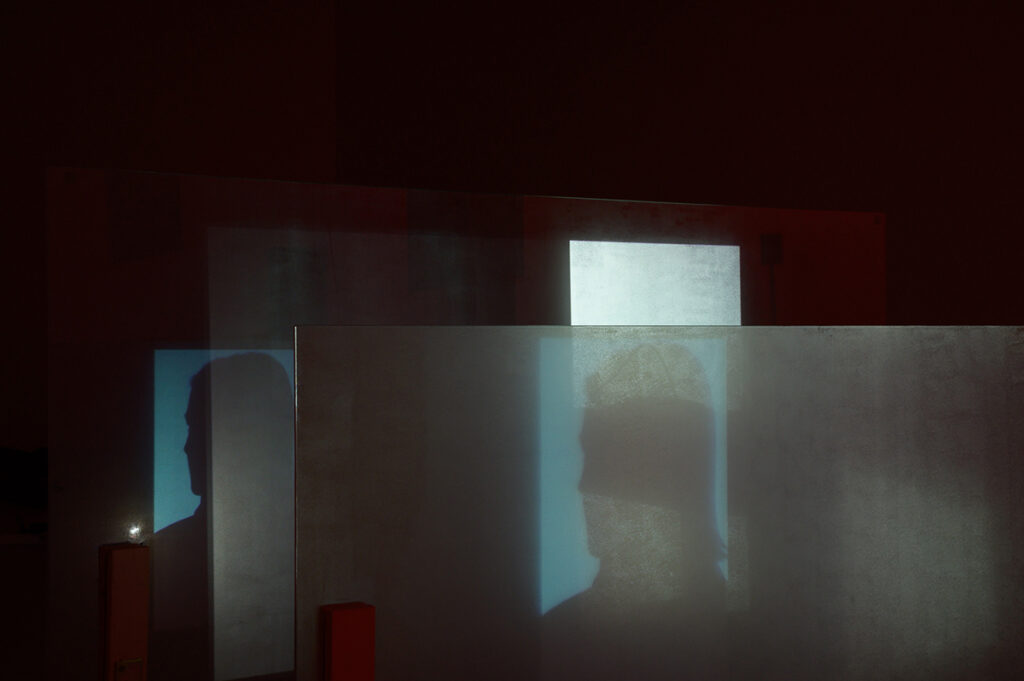
hypertopia

2021 | video projections on glass | Exhibition view Landscapes of Internet, Kunsthaus L6 Freiburg 2021

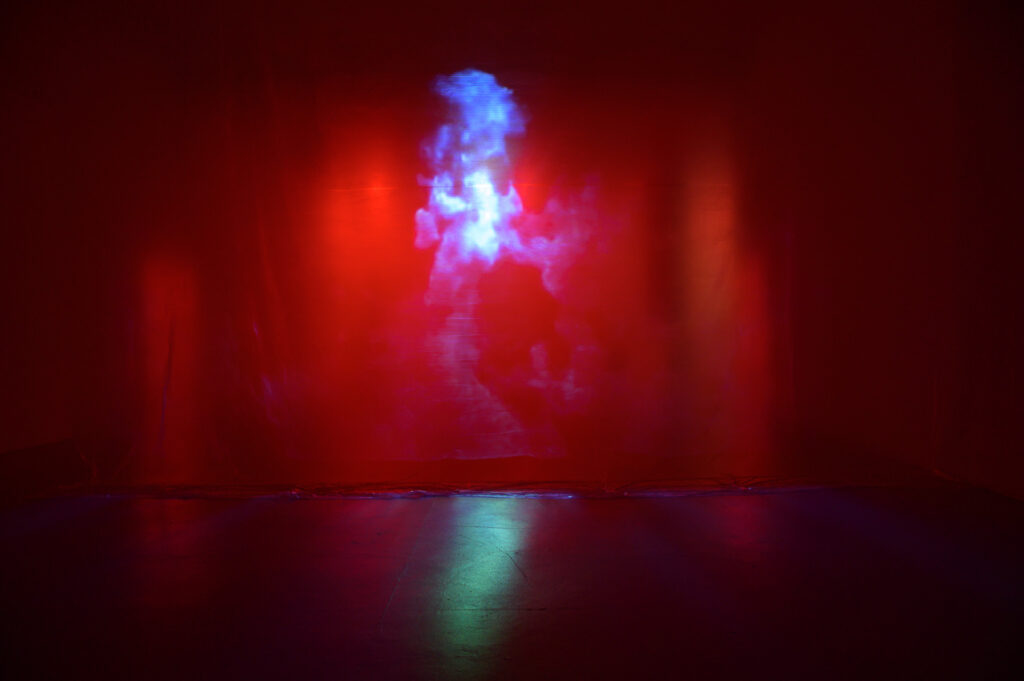
Hypertopia is an attempt to localize digital space and make it visible. A projectionless but permeable space is created between the glasses, whereby a third projection level appears in the airspace behind the glasses.

Photo: Marc Doradzillo

camouflage

2021 | 7-part series, videocall-stills (Microsoft skype) on Aludibond, each 30 x 53 cm

Almost every video telephony service offers its users the option to change the image background. Many people are not aware that this is only possible through the use of facial recognition software. It is also unclear how the companies use the data obtained in this way. In the series camouflage I use simple physics to push the technology to its limits: through movement, light and shadow I confuse the facial recognition software and thus escape the deceitful practices of the companies.

Chronicles of Labour

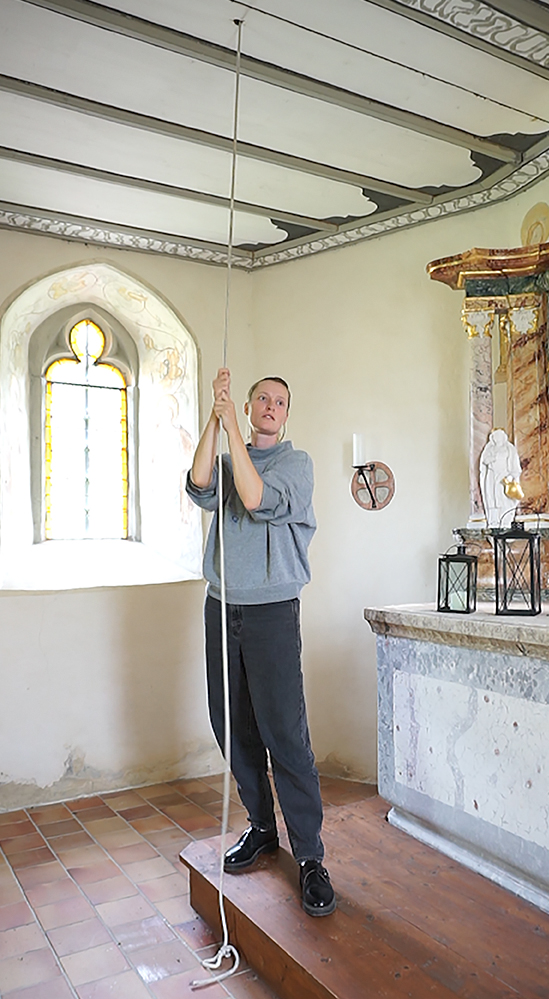
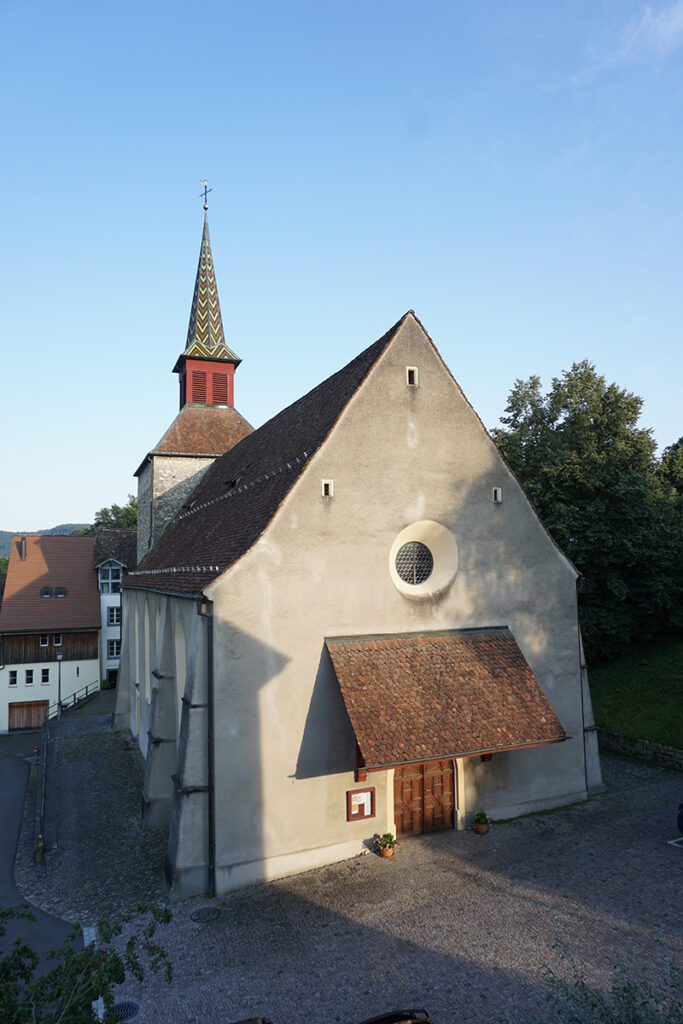
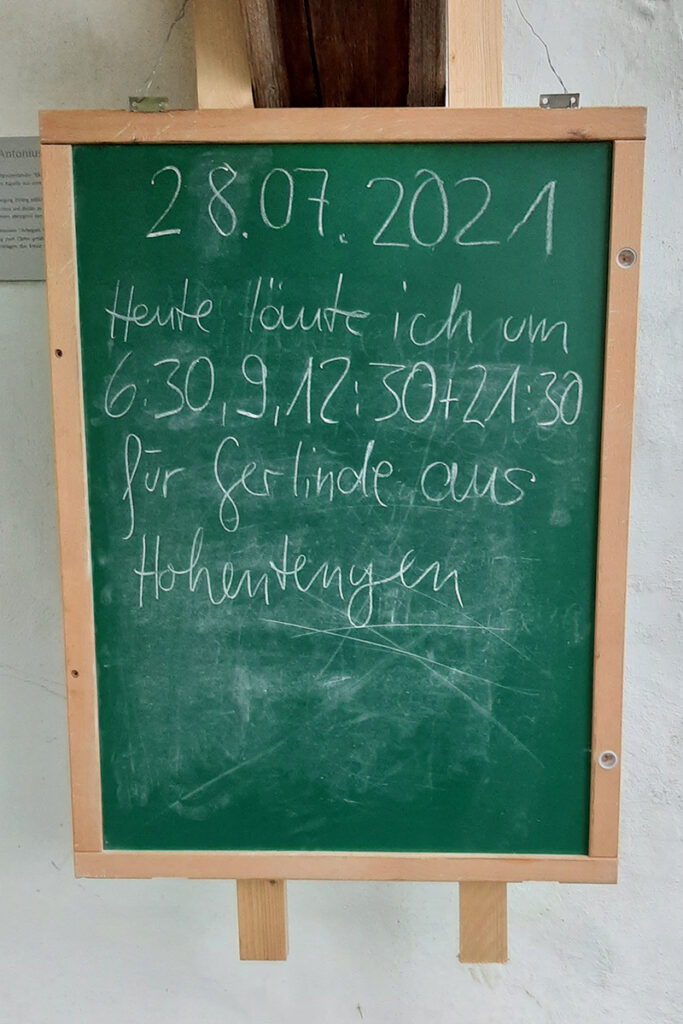
2021 | 3 minutes of bell tolling several times a day from July 24 until September 5, according to the input of locals | performance view Hochrhein-Triennale Hohentengen (DE)/Kaiserstuhl (CH)


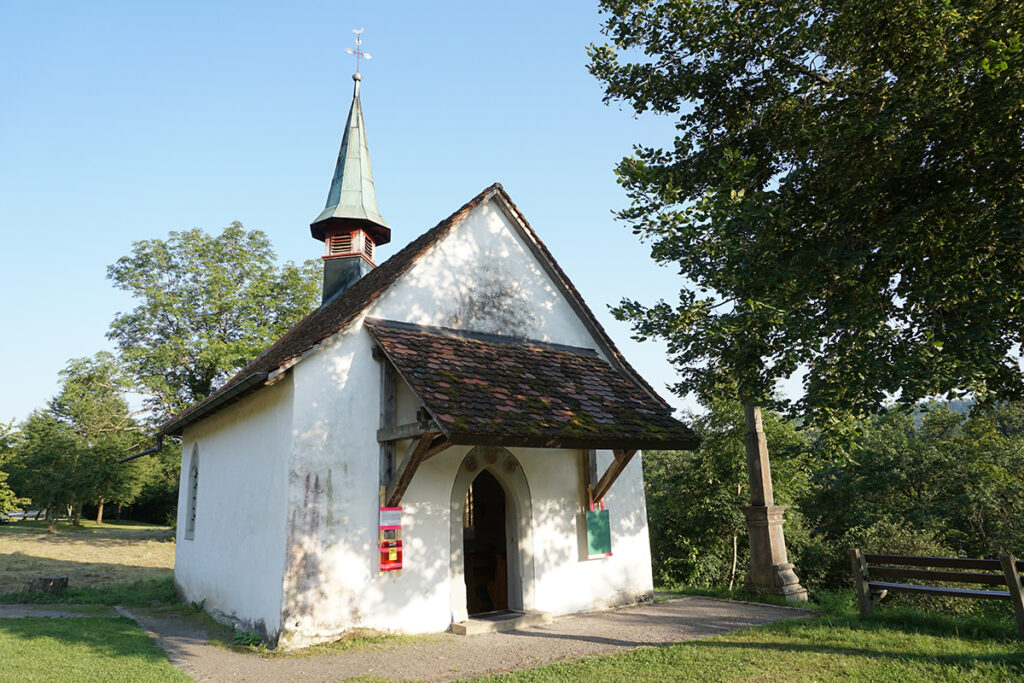
6, 11, 16 and 19 o‘clock are the times at which the bells of St. Katharina in Kaiserstuhl ring every day, for several minutes. This is the so-called Angelus ringing, which from the Middle Ages until the middle of the 20th century, in addition to the function of the call to prayer, also had the function of structuring the daily work of the population working in agriculture.
Based on the questions to what extent these prayer times are still relevant today and what meaning they have for today‘s population, Chronicles of Labour takes up this duality and tries to approach our pluralistic working and living worlds of today through individual ringing times. Over a period of 6 weeks, an acoustic portrait of the work realities and activity rhythms of the local population is created: every day, I ring the bells in St. Antonius for a different person in the region, according to their individual specifications. Three minutes of bell ringing, which announces choir rehearsals, joint meetings, yeast activations, animal feedings, meal times, regulars‘ tables, school vacations, work times, aperos, bed times, coffee breaks, visits, …all sorts of human and non-human, formal and informal activities around here.
The work also critically engages with the construct of (wage) work, appreciation of work and questions systemically imposed time regulatory structures.


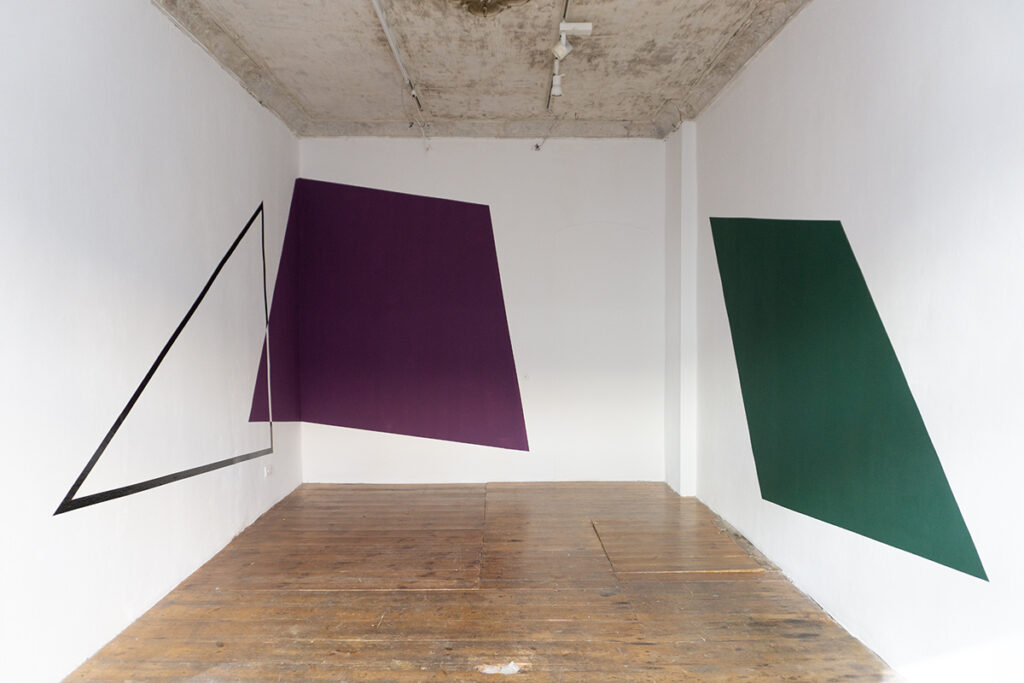
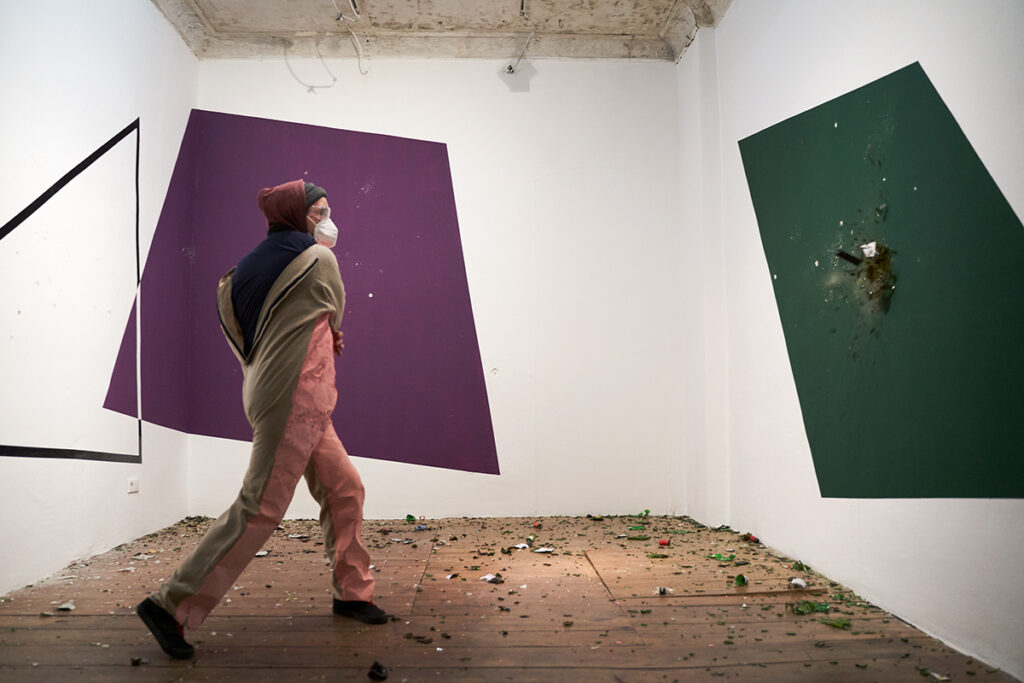
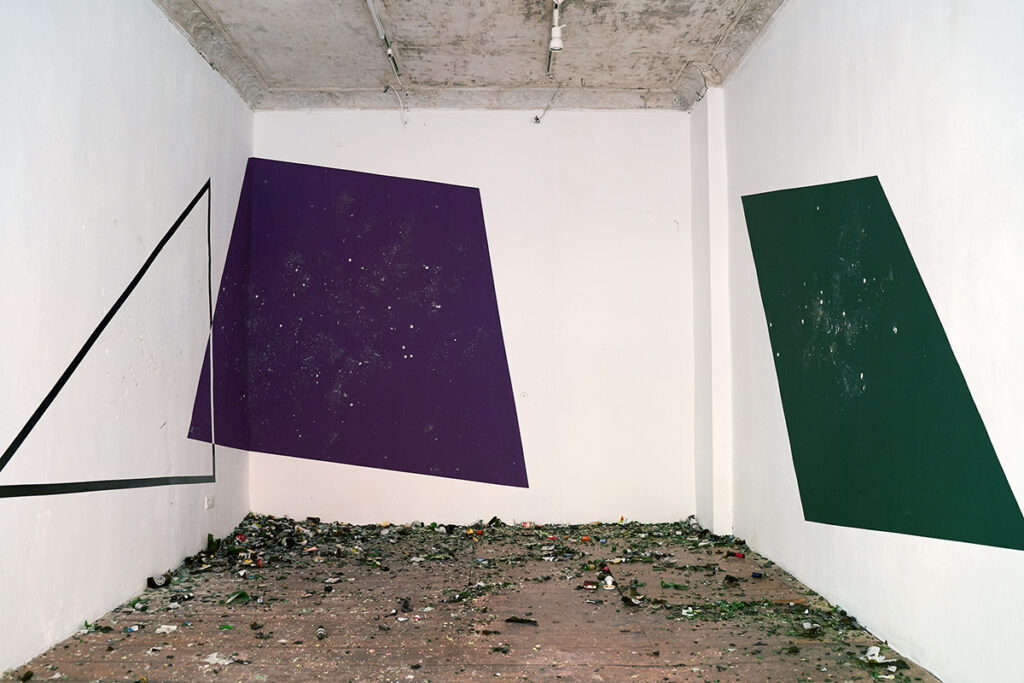
ANT AGR BER

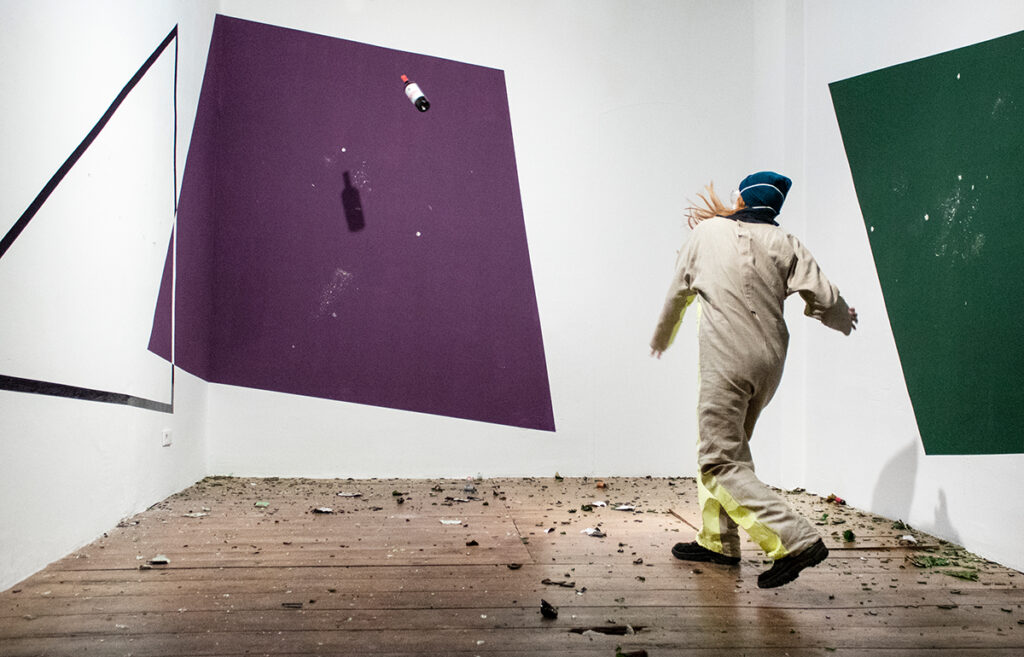
2021 | 3 different colored throwing areas, one for each glass color, throwing actions of the visitors with self-brought waste glass
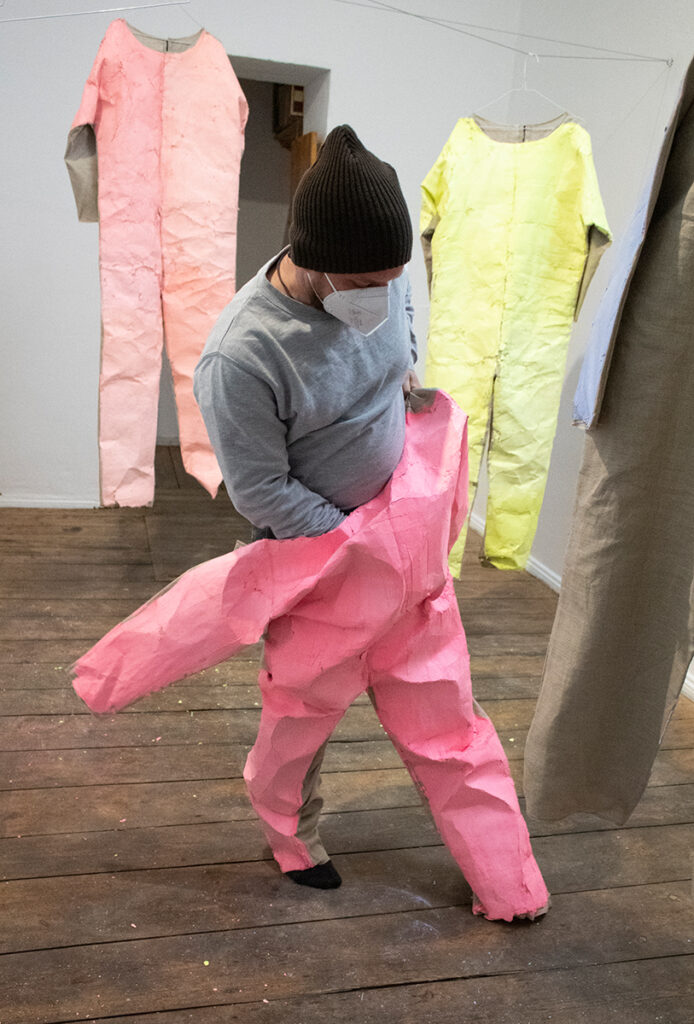
cooperation with Nadjana Mohr | suits blueyellowpinkrosa (SMLXL / 4 suits, body sizes 160 cm – 190 cm) / vinyl / plaster / linen / wire | Raum für drastische Maßnahmen Berlin

Photos: Nadjana Mohr, Ana Baumgart


Raum für drastische Maßnahmen means „space for drastic measures“. The question of our relationship to spaces is pressing upon us drastically, intensified by the current situation. A space offers protection, but at the same time it can constrict or seal off. In short, space becomes a source of friction, a literal boundary to which one comes. These boundaries are currently experienced not only physically, but also psychologically: the absence of any physicality in digital space puts our psyche to the test. In favor of the overstraining of the thinking center, the remaining part of our bodies is undergoing a radical withdrawal cure due to the lack of contact with other people and generally limited freedom of movement. The longing for real experiences grows, we want to actively experience reality again, not just be passive observers in front of a screen. Our actions should again show a visible result that is more than just clicking to the next Netflix episode.

Interview:


Video documentation:

Video and editing Sophie Innmann